
Mindful Eating
Notes on Eating Without Distraction
Tobias Ashcroft
·

There is something disarmingly simple about a well-composed meal. Not simple in the sense of effortless — a genuinely balanced plate asks for attention, for a working knowledge of macronutrients, for the patience to source seasonal produce and the willingness to cook rather than assemble. But simple in the sense that its governing logic, once understood, rarely needs to change.
Contemporary nutritional guidance, drawn from published dietary research across the United Kingdom and beyond, consistently points toward a similar structural model: roughly half the plate occupied by non-starchy vegetables and fruit, a quarter by whole-grain or complex carbohydrate sources, and the remaining quarter by a protein-rich component. The proportions shift depending on individual energy requirements and activity levels, but the broad architecture holds.
This is not a prescriptive template — it is a proportional framework. A warm lentil salad with roasted root vegetables and a handful of pumpkin seeds sits within it. So does a bowl of brown rice, grilled fish, and a side of steamed leafy greens. The framework accommodates cultural variation, seasonal availability, and personal preference without demanding adherence to a narrowly defined set of foods.
What the framework does demand is honest assessment. Most people underestimate the carbohydrate portion and overestimate the vegetable component. A plate that is two-thirds pasta with a modest garnish of spinach is not the same as one where the grain sits alongside a generous quantity of colour. The distinction matters, not because pasta is harmful, but because the nutritional density of the meal shifts considerably when the proportions are reversed.
"The nutritional density of a meal shifts considerably when the proportions are genuinely considered rather than estimated."
Fibre remains one of the most consistently under-consumed nutrients in the British diet. The National Diet and Nutrition Survey has reported for successive years that average adult intake falls below the recommended 30 grams per day — a figure itself derived from a substantial body of published nutritional research linking adequate fibre consumption with markers of digestive health, sustained energy levels, and long-term weight management.
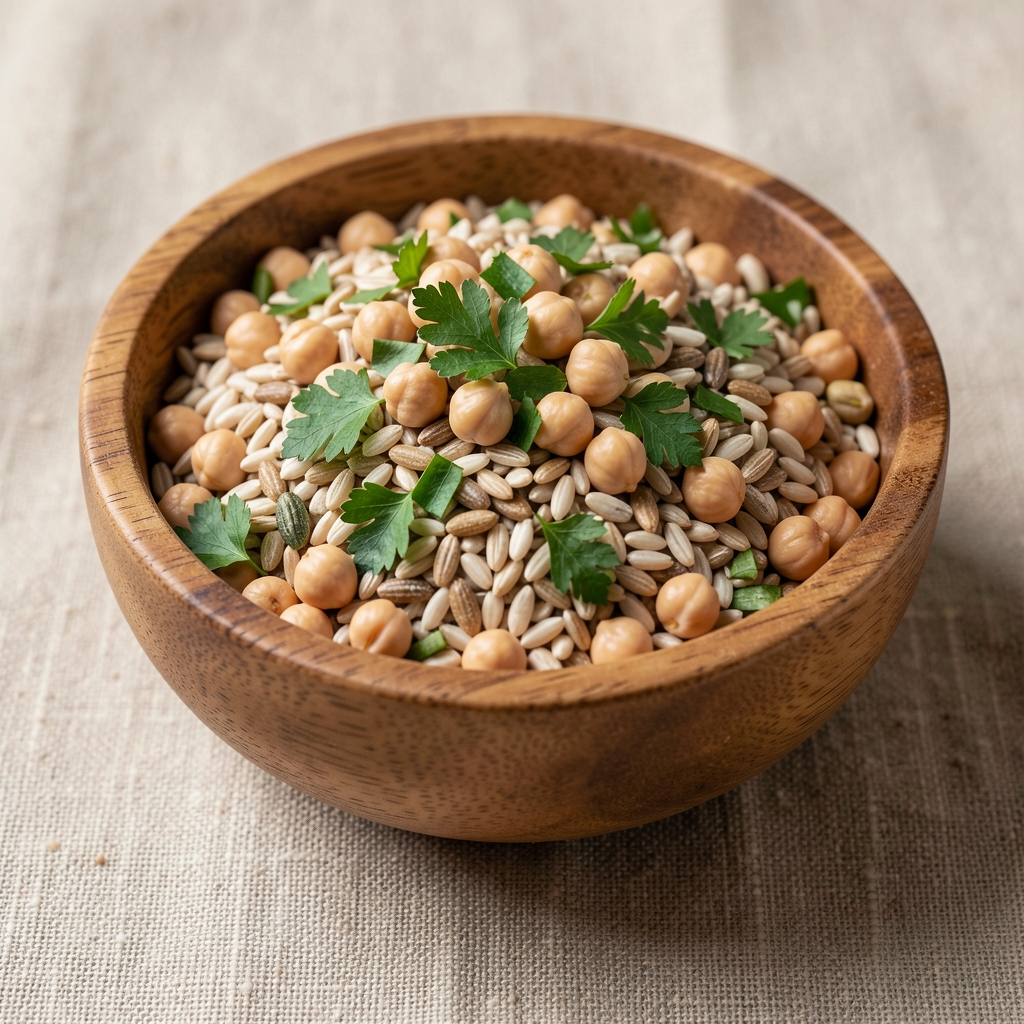
The practical route to increasing fibre intake is less complicated than it might appear. Switching from refined to whole-grain bread and pasta accounts for a meaningful proportion of the gap. Incorporating legumes — lentils, chickpeas, black beans — into two or three weekly meals is another straightforward step. The evening meal is often the most efficient moment to address the shortfall: a serving of roasted vegetables alongside a grain-based component can contribute 10-14 grams in a single sitting.
What matters alongside fibre is hydration. Dietary fibre functions most effectively when accompanied by adequate fluid intake — something that many people overlook when increasing the roughage component of their diet. The two adjustments are most usefully made together: more fibre, more water, introduced gradually over a period of weeks rather than abruptly.
Calorie counting is one approach to portion awareness, but it is not the only one — and for many people it is not a sustainable one. The cognitive load of tracking every meal can introduce an anxious relationship with food that proves counterproductive over time. An alternative is the development of visual and sensory reference points that do not require scales or apps.
Qualified nutrition professionals often describe a practical hand-based system: a cupped palm of cooked grain, a fist of vegetables, a palm-sized protein portion, a thumb of fat-rich food. These are rough guides, not precise measurements — their value lies in the consistency of the reference point rather than its accuracy to the gram. A hand does not change size from meal to meal, which is precisely what makes it a useful tool.
The more significant practical skill is reading satiety cues. Many people eat past the point of comfortable fullness not because they are inattentive but because the pace of a meal outstrips the body's signalling speed. Digestion and satiety signalling operate on a delayed feedback loop — the sense of fullness following a meal typically becomes clear 15-20 minutes after the meal concludes. Eating more slowly, pausing between courses, and removing distractions during meals are all documented approaches to aligning eating pace with that feedback loop.
The case for seasonal cooking is simultaneously practical and nutritional. Produce harvested at peak ripeness and consumed within a short supply chain retains a higher concentration of water-soluble vitamins and phytochemicals than produce picked early and transported over long distances. This is not a claim that out-of-season vegetables are nutritionally negligible — they are not — but there is a measurable difference, documented in published food science literature, between fresh-harvested and extended-storage versions of the same vegetable.
The seasonal rhythm also provides a useful constraint that many home cooks find clarifying. Rather than confronting an undifferentiated global market of available ingredients, the seasonal approach narrows the field: late winter means root vegetables, brassicas, and pulses. Spring introduces asparagus, peas, and early salad leaves. Summer brings tomatoes, courgettes, and stone fruit. Autumn returns to squash, beetroot, and the apple harvest. The rhythm imposes a creative discipline that often produces more varied, nutritionally diverse eating than an unconstrained approach allows.
Meal preparation — the practice of cooking larger quantities in advance and storing portions for the week ahead — is perhaps the most reliable structural support for consistent home cooking. A batch of cooked whole grains, a prepared dressing, and a selection of roasted or raw vegetables assembled on a Sunday afternoon provide the foundation for four or five lunches or dinners with minimal daily effort. The time investment is front-loaded; the weekly benefit accrues with each meal drawn from it.
The language around weight management in popular media tends toward urgency — rapid results, dramatic before-and-after trajectories, numbered-day programmes. The published evidence on sustainable weight approach points in a different direction entirely. Gradual, consistent changes to the composition and quantity of daily eating, sustained over months rather than days, produce more stable outcomes than intensive short-term interventions.
This is not an argument against ambition. It is an argument for patience and for the kind of structural changes to the kitchen routine — more seasonal produce, more home-cooked meals, more attention to portion proportion — that become habitual rather than effortful. The plate is not a problem to be solved once. It is a practice to be maintained. And like most practices worth maintaining, it rewards consistency over intensity.
Ordan Dispatch is an independent editorial publication focused on everyday wellness practices. The publication is not affiliated with any commercial, governmental, or institutional body. Articles published here are editorial in nature and reflect the writers' observations on everyday wellness practices. The content is not intended as professional guidance, nor as advice for the management of any specific condition. Readers with specific concerns about their daily routines are encouraged to speak with a qualified wellness professional.

Eleanor Whitfield is the founding editor of Ordan Dispatch. Her writing focuses on the practical intersection of nutritional research and the everyday kitchen — the habits, rhythms, and considered choices that constitute a genuinely balanced approach to food.
More from Eleanor →