Everyday Nutrition
The Quiet Logic of a Balanced Plate
Eleanor Whitfield
·

In the British grocery landscape, the seasons have become largely invisible. Strawberries arrive in January, asparagus in December, and the tomato shelf remains constant across the year. This is not a complaint about availability — the global supply chain has demonstrably broadened the range of foods accessible to the home cook at any time of year. It is an observation about what has been quietly lost: the structured variation that seasonal eating once imposed on the kitchen calendar, and the nutritional and culinary benefits that accompanied it.
The nutritional argument for seasonal produce is grounded in published food science rather than in sentiment. Water-soluble vitamins — notably vitamin C, folate, and the B-group vitamins — degrade progressively during storage and transportation. Produce that travels 4,000 miles under refrigeration arrives with measurably lower concentrations of these vitamins than the same produce consumed within days of harvest. The degradation is not uniform across all nutrients: fat-soluble vitamins (A, D, E, K) are more stable in transit, as are minerals. The practical implication is that the nutritional benefit of seasonal eating is most pronounced for produce eaten fresh and consumed soon after harvest.
Phytochemicals — the broad category of plant-derived compounds associated with various aspects of long-term health — show a similar pattern. Research from the Cranfield Institute and other bodies studying post-harvest biochemistry has documented declining phytochemical concentrations in produce stored for extended periods at controlled temperatures. Fresh-harvested, in-season produce does not merely taste better — it consistently presents a more complete nutritional profile than its extended-storage equivalent.
This does not mean that out-of-season vegetables are nutritionally negligible. They are not. A bowl of Spanish tomatoes in February still contributes lycopene, vitamin C (in reduced quantity), and dietary fibre. The case for seasonal eating is one of degree rather than kind — a consistent preference for in-season, shorter-supply-chain produce produces a measurably better outcome over time, without requiring the complete rejection of out-of-season alternatives.
"Fresh-harvested, in-season produce does not merely taste better — it consistently presents a more complete nutritional profile than its extended-storage equivalent."
The United Kingdom has a more varied growing calendar than many of its residents realise. The perception that Britain's agricultural output is limited to a narrow range of crops is largely a product of supermarket homogenisation rather than of genuine agronomic reality. The British growing year, tracked by organisations including the Soil Association and the National Farmers' Union, encompasses a wide range of vegetables, fruits, and legumes across twelve months.
Winter (December through February) is dominated by brassicas — kale, cavolo nero, Brussels sprouts, purple sprouting broccoli — along with root vegetables (parsnips, celeriac, swede, carrots), storage squashes, and leeks. These are not lesser ingredients; they are the foundation of some of the most nutritionally dense dishes in the British culinary tradition. A slow-roasted celeriac with a pulse-based accompaniment is, on most nutritional metrics, a more substantial meal than a salad of out-of-season leaves.
Spring (March through May) introduces asparagus, the first new potatoes, spring onions, peas (as the season advances), radishes, and early salad leaves. Summer (June through August) broadens the palette considerably: tomatoes, courgettes, cucumbers, runner beans, broad beans, beetroot, chard, and the soft fruit harvest — raspberries, strawberries, gooseberries, currants. Autumn (September through November) returns to the root and squash families, adds wild mushrooms (in the formal forage season), apples, pears, and late-season brassicas.
Knowing this calendar — not as an exhaustive reference but as a working orientation — is the practical foundation of seasonal cooking. It does not require a subscription to a box scheme or proximity to a farmers' market, though both help. It requires only a willingness to ask, at the supermarket or the greengrocer, what is currently in season, and to organise the week's cooking around the answer.
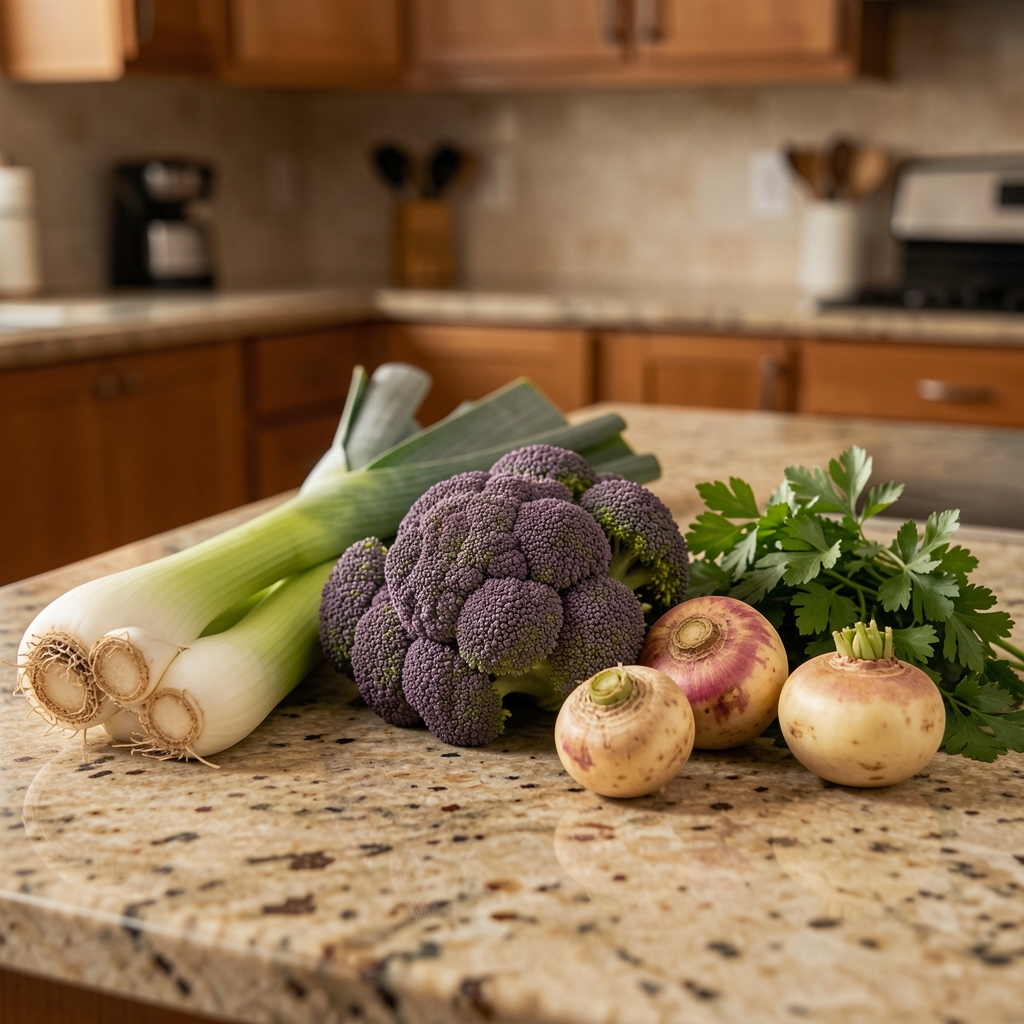
The connection between seasonal eating and gut health is a useful frame for thinking about dietary variety. The gut microbiome — the community of microorganisms inhabiting the digestive tract — responds to diversity in plant-based food intake. Research published in journals including the British Journal of Nutrition and Gut has documented that higher diversity of plant foods in the diet correlates with greater diversity in the gut microbiome, which in turn correlates with markers of general digestive function.
Seasonal eating, by definition, introduces variety over time. A kitchen that follows the British growing calendar will consume kale and celeriac in winter, asparagus and peas in spring, courgettes and broad beans in summer, and squash and chard in autumn. Each of these plant foods provides a different fibre composition and a different set of phytochemicals, collectively feeding a broader range of microbial communities than a year-round reliance on the same five or six vegetable staples would allow.
Fermented foods — another category with documented relevance to gut-friendly eating — can be incorporated alongside seasonal produce without any specialised equipment or preparation. Natural yoghurt, kefir, unpasteurised soft cheeses, sourdough bread, and traditionally produced condiments (sauerkraut, kimchi, miso) all contribute live cultures. Their inclusion in a few meals per week, alongside adequate fibre from seasonal plant foods, represents a practical and well-evidenced approach to the dietary dimension of digestive health.
The most common obstacle to seasonal cooking is not motivation but structure. Without a working framework for the week's meals, the path of least resistance leads back to the same familiar purchases regardless of what is actually in season. A minimal weekly menu structure — not a rigid meal plan but a loose framework with designated categories — is the most reliable solution to this problem.
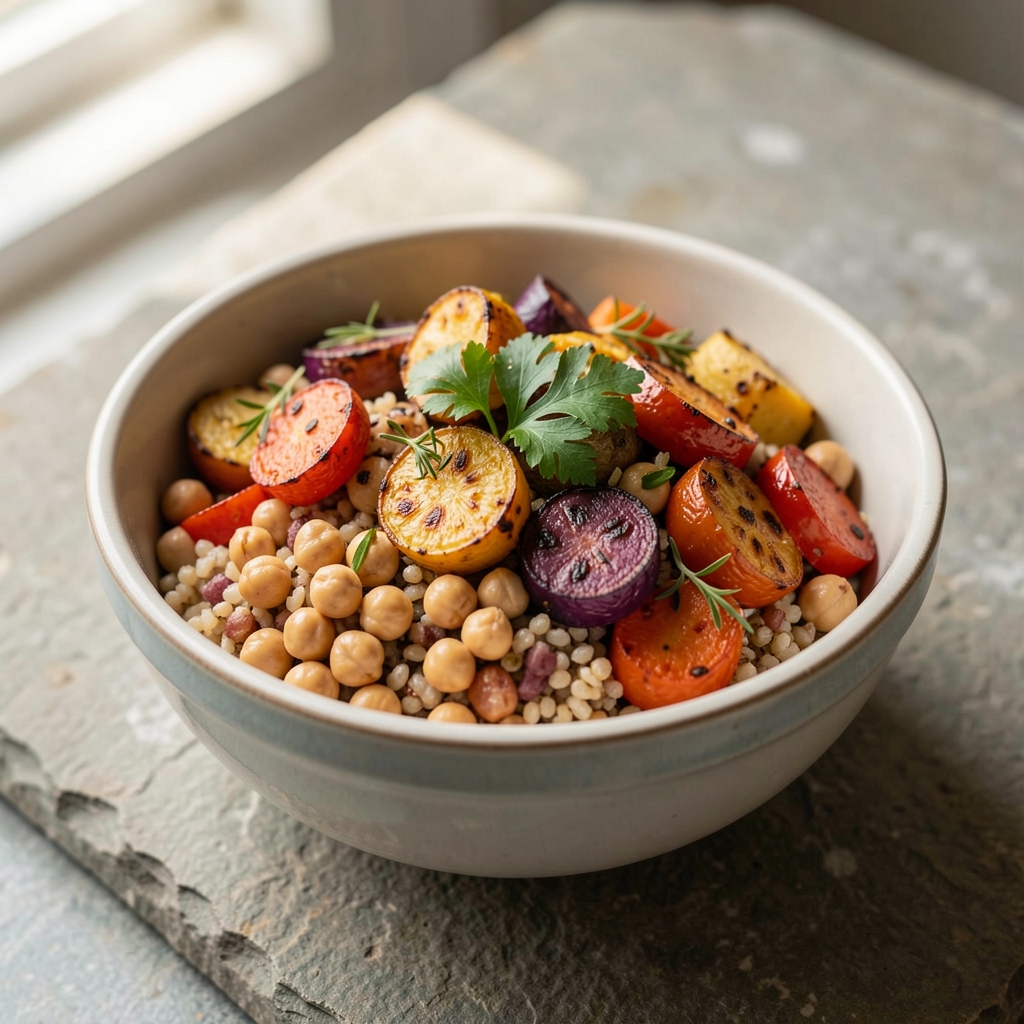
One approach, drawn from the meal preparation literature and adapted for the seasonal context: designate one day per week (Sunday is most common, though Saturday morning with a market visit works well) as the preparation day. On that day: cook a batch of a whole grain (brown rice, farro, pearl barley, or spelt — rotated weekly for variety), prepare a legume or pulse component (roasted chickpeas, a lentil dal, black bean base), and wash and rough-chop a selection of the week's seasonal vegetables, storing them in the refrigerator for rapid assembly into meals during the week.
With these components prepared, the evening meals of the following four days can each be assembled in under 20 minutes: grain base plus seasonal vegetable plus protein component, dressed and seasoned differently each day. The structural variety comes from the seasonal ingredient changing with the weeks; the efficiency comes from the preparation being front-loaded into one sustained session rather than distributed across daily cooking from scratch.
A note on sustainability and cost: seasonal British produce is, in most cases, cheaper than its imported, out-of-season equivalent. The premium paid for a Spanish tomato in January is real and measurable. Aligning weekly shopping with the seasonal calendar is not merely a nutritional or culinary choice — it is frequently the most cost-effective one.
There is a final dimension to seasonal eating that is rarely discussed in nutritional terms but is well documented in the anthropological and sociological literature on food culture: its social function. The seasonal meal has historically been the occasion for shared cooking, shared knowledge, and shared table. The autumn preserve-making afternoon, the spring asparagus dinner, the summer soft-fruit jam — these are not merely culinary events but social ones, structured around the particular produce of a particular moment in the year.
This is not a nostalgic argument for a return to some imagined culinary past. It is an observation that the rhythm of seasonal eating naturally creates occasions for the kind of unhurried, attentive shared meal that the research on mindful eating identifies as most beneficial. A Sunday afternoon spent preparing a seasonal batch cook with another person is, at once, a practical meal-preparation session and a social activity structured around food rather than around the food being incidental to some other activity.
The calendar, in this sense, is not only a guide to what to buy. It is a gentle structure for when and how to cook — a framework that makes the home kitchen, over the course of a year, a more varied, more nutritionally grounded, and more socially animated space than a year-round reliance on the same convenience staples allows.
Ordan Dispatch is an independent editorial publication focused on everyday wellness practices. The publication is not affiliated with any commercial, governmental, or institutional body. Articles published here are editorial in nature and reflect the writers' observations on everyday wellness practices. The content is not intended as professional guidance, nor as advice for the management of any specific condition. Readers with specific concerns about their daily routines are encouraged to speak with a qualified wellness professional.

Eleanor Whitfield is the founding editor of Ordan Dispatch. Her writing focuses on the practical intersection of nutritional research and the everyday kitchen — the habits, rhythms, and considered choices that constitute a genuinely balanced approach to food.
More from Eleanor →